

 English
 Français
 Russian
 Català
 Español
 Deutsch
 Nederlands
 Italiano
 Português PT
 Polski
 Română
 Svenska
 Bokmål
 Suomi
Suomi Dansk
Dansk Magyar
 Čeština
 ελληνικά
 български език
 Slovenčina
 Hrvatski
 Slovenščina
 Lietuvių kalba
 Latviešu valoda
 Eesti keel


Baroque furniture makes a strong impression. It catches the eye, embraces curves, carved details, gilded finishes, deep velvets and theatrical lines. That is precisely what gives it its strength… but also what can make it intimidating when you want to integrate it into a contemporary interior.
Many people still imagine Baroque style as something heavy, excessive, reserved for castles or very classical interiors. Yet, when used with balance, a Baroque armchair, a gilded console, a chaise longue or a carved sofa can become a magnificent centrepiece in a modern home. Everything depends on proportion and restraint.
Baroque style does not have to be kitsch
Kitsch does not come from Baroque furniture itself. It usually comes from an excess of staging. Too many gilded pieces, too many patterns, too many strong colours, too many decorative objects around it: this kind of accumulation quickly overwhelms the eye.
In a contemporary interior, Baroque furniture works much better when treated as a statement piece. It becomes a decorative accent, almost like a work of art, rather than an element lost in an already overloaded setting.
.webp)
Large Baroque porter's armchair in mauve velvet and silver wood in a contemporary interior
The statement piece rule
The simplest rule for successfully integrating Baroque furniture into a modern decor is the statement piece rule. One strong piece is often enough to give an entire room character.
A carved armchair in a reading corner, a spectacular sofa in a sober living room, a gilded console in an entrance hall or a velvet bench in a bedroom can immediately transform the atmosphere. The idea is not to match everything, but to create a focal point.
- In a living room: a sofa or armchair can become the central piece.
- In an entrance hall: a gilded console structures the wall at first glance.
- In a bedroom: a bench or chaise longue adds a theatrical touch.
- In an office: a Baroque armchair can soften the coldness of an overly functional setting.
.webp)
Two-seater Rococo Baroque sofa in royal blue velvet and gilded wood in a contemporary living room
Pairing Baroque furniture with contemporary materials
To avoid a frozen, old-fashioned decor, Baroque furniture should be combined with contemporary materials. The contrast between carved lines and sober materials makes the whole composition feel more modern.
- Travertine softens gilded finishes and brings mineral elegance.
- Black metal adds structure and prevents the look from becoming too precious.
- Glass visually lightens the composition.
- Neutral walls allow statement pieces to breathe.
- Light floors enhance brightness and balance deep colours.
This mix between ornament and sobriety is what allows Baroque style to feel contemporary. The furniture keeps its soul, while the space around it gives it a more current interpretation.
.webp)
Louis XV Rocaille Baroque console in gilded wood and beige marble with a black and white artwork
Daring to use graphic contrasts
Baroque furniture does not have to be classical in its fabric or colour. A black and white striped armchair, a deep velvet, an animal print or a very contemporary shade can completely change the way the piece is perceived.
The lines remain Baroque, but the visual treatment becomes more graphic. This is an excellent way to integrate a carved piece into a modern house, a contemporary villa or a more minimalist setting.
.webp)
Large Royal Baroque-style armchair in black and white stripes with gilded wood
Creating a gallery-like atmosphere
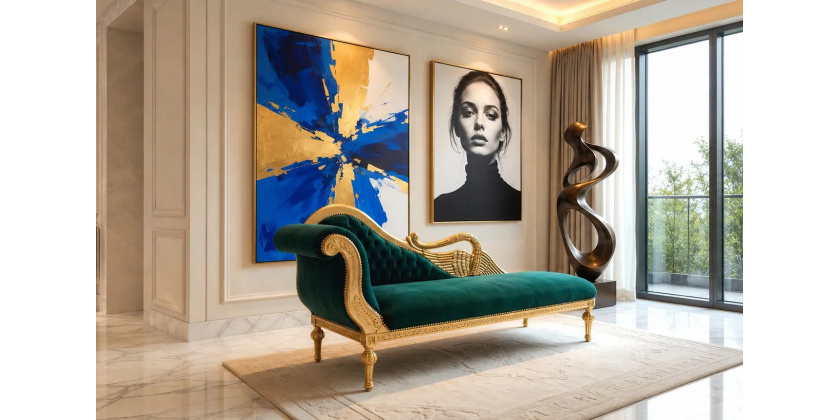
Baroque furniture works particularly well when it enters into dialogue with contemporary art. A carved armchair placed in front of a large abstract canvas, a velvet chaise longue beneath a wall composition, or a gilded console paired with a modern artwork: these contrasts create the atmosphere of a private gallery.
Baroque furniture brings material, curves and detail. Contemporary art brings contrast, colour, movement and verticality. Together, they create a living decor that feels more personal than a fully coordinated interior.
.webp)
Large Baroque swan-neck recamier in green velvet and gilded wood with contemporary artworks
Baroque furniture in professional spaces
Baroque furniture is not reserved for private interiors. It can also become a powerful staging tool in a hotel, restaurant, boutique, showroom or high-end hair salon.
In a professional space, furniture does not only serve a practical purpose. It contributes to the customer experience. A spectacular armchair, a velvet bench or a carved console can make a space more memorable, more photogenic and more distinctive.
A well-placed statement piece can be enough to create a premium atmosphere: in a waiting area, a corner, an entrance or a reception space.
.webp)
Large Baroque porter's armchair in red velvet and black wood displayed in a luxury boutique
The mistakes that create a kitsch effect
To integrate Baroque furniture without falling into excess, some mistakes should be avoided. The problem does not always come from the style itself, but from the way it is balanced.
- Accumulating too many Baroque pieces in the same room.
- Mixing several strong colours without a clear visual direction.
- Combining gilded finishes, dark walls, heavy curtains and busy rugs without visual breathing space.
- Choosing furniture that is too large for the room.
- Forgetting lighting, which can make gilding appear too aggressive or velvet too dark.
- Trying to match everything instead of creating a controlled contrast.
The right approach is to leave space around the furniture, limit competing elements and choose a coherent colour palette.
.webp)
The bench: spectacular yet easy to place
A Baroque bench is an excellent alternative to a sofa or a large armchair. Less bulky and easier to integrate, it can dress up an entrance hall, the foot of a bed, a dressing room, a boutique or a waiting area.
In burgundy and gold, it immediately brings warmth and a theatrical presence without taking over the entire space. It is a strong piece, but more flexible to use than a large sofa.
.webp)
Roman bench in burgundy velvet and gilded wood
Conclusion: Baroque becomes modern when it is well balanced
Integrating Baroque furniture into a contemporary interior is not a design mistake. On the contrary, this contrast often gives a room more depth and character. But everything depends on how the piece is staged.
An armchair, a console, a recamier, a bench or a sofa can be enough to transform an entire room. It simply needs space around it, contemporary materials nearby and no unnecessary accumulation.
When well chosen and well placed, Baroque furniture does not look kitsch. It becomes a visual signature, a character piece, capable of bringing to a modern interior what it sometimes lacks: warmth, personality and a true decorative presence.
Leave a Reply Cancel Reply